
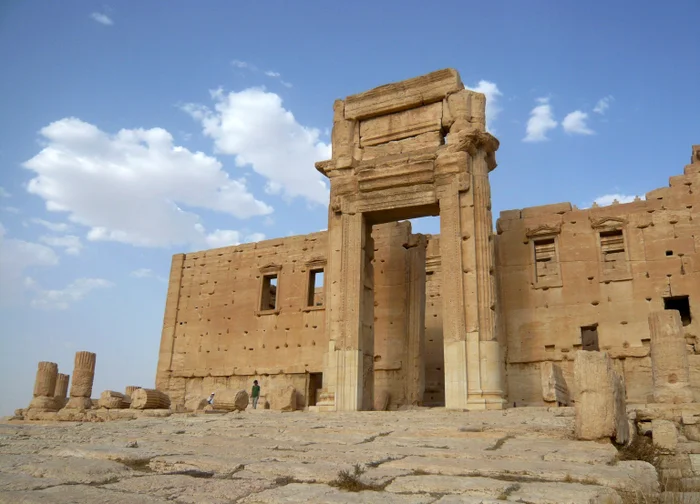
Religious life in ancient Palmyra was a diverse and complex reflection of the city’s cosmopolitan character. Over the first three centuries CE, the Palmyrenes practiced a blend of local and foreign cults, honoring numerous deities through temples, rituals, artistic depictions, and priesthoods. Archaeological evidence, rather than ritual texts or mythological narratives, provides most of what we know, as thousands of inscriptions found on-site rarely mention prayers or liturgies. However, monumental architecture and sacred objects reveal the ceremonial importance of religion in Palmyrene society. For example, the colonnaded street leading to the Great Altar and the ritual basin in the Temple of Bel, used for animal sacrifices, demonstrate the central role of religious traditions in civic life.
Palmyra was home to a wide range of cults representing both local and foreign deities. Two major temples , those of Bel and Baalshamin ,survived into the modern era because they were converted into a church and a mosque respectively. Excavations across the city have uncovered sanctuaries and inscriptions dedicated to deities considered “native” as well as those of foreign origin. Deities such as Yarhibol, Aglibol, Allat, Shamash, and Nabu illustrate Palmyra’s ties to Babylonian, Phoenician, Canaanite, and Greek religious traditions rather than Roman ones. Historical and linguistic evidence reflects the city’s eastern orientation and the cosmopolitan, pluralistic nature of its inhabitants.
Although no synagogue has been found on-site, Hellenistic sources confirm the presence of a substantial Jewish population. This community played an active role in shaping Palmyra’s multi-ethnic and multi-religious society.
The supreme Palmyrene god was Bel, whose name derives from “Baal” or “Bûl.” He was often depicted alongside other prominent local gods such as Yarhibol, associated with the sun and the sacred spring of Efqa, and Aglibol, the moon god. Other figures connected to Bel included Malakbel (the “angel” or messenger of Bel) and Bol-Astor, also known as Baal-Astarte. The military deity Arsu maintained his original name and was associated with the Greek god Ares.
The Palmyrenes adopted a variety of deities from surrounding regions. From Mesopotamia came gods such as Nabu, the divine scribe and deity of wisdom, as well as Shamash and Nergal. Urban centers of Syria contributed major cults like that of Baalshamin, “Lord of the Heavens,” who brought rain and fertility. The famous Syrian goddess Atargatis, revered as the great mother and mistress of animals in northern Syria, was also worshipped in Palmyra.

Arabian and nomadic cults were likewise integrated. The warrior goddess Allat and Sha’i al-Qawm, the deity described as “the one who does not drink wine,” are two notable examples. Palmyra also welcomed more distant influences, such as the Phoenician god Shadrapha and the Egyptian Baal Hammon. A smaller number of Greek deities preserved their Greek names, including Heracles, Tyche, and Nemesis. Linguistic and visual equivalences were frequently devised; for instance, Bel and Baalshamin were identified with Zeus in Greek texts, and syncretic iconographies were created, such as the statue of Athena dedicated in the Temple of Allat.
Major temples served not only the principal deity but also hosted secondary gods that lacked their own shrines. Religious practices included ceremonial processions and especially commemorative banquets. Participation in these events was often by invitation, as indicated by thousands of tokens made of clay or metal. These tokens bore images or symbols of the deity associated with the occasion and were used as entry markers to ritual feasts.
The religious landscape of Palmyra was defined by diversity, adaptation, and interaction. Local traditions coexisted with and were enriched by foreign influences from Mesopotamia, Syria, Arabia, Phoenicia, Egypt, and Greece. Through its temples, rituals, priesthoods, and iconographies, Palmyra expressed a distinctive form of spiritual pluralism that reflected its role as a cultural crossroads of the ancient Near East.


